10,000 Steps a Day: Calories Burned and Weight Loss
How many calories do 10,000 steps actually burn, and will walking 10,000 steps a day help you lose weight? Here are realistic numbers by body weight and walking speed, how they are worked out, and what the latest research says about step counts.
Quick answer
For most adults, 10,000 steps burns roughly 330 to 690 calories in total, depending mainly on body weight and walking speed. Roughly 70 to 80% of that is extra energy on top of what your body would burn anyway at rest. That extra part, about 240 to 540 calories, is the number that matters for weight management.
Estimates only. Your own figure depends on your weight, stride, pace, incline and fitness.
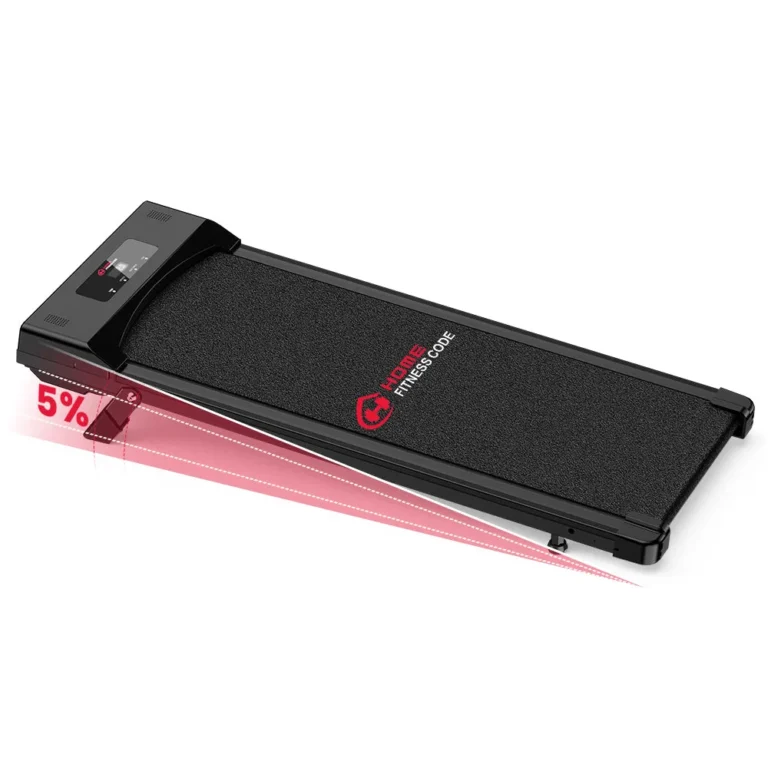
Home Fitness Code Z3 walking pad
If the weather or a desk job keeps your step count low, a walking pad lets you add steps indoors. The Z3 is a compact walking-speed pad with a brushless motor, a 1 to 6 km/h speed range and a 5% manual incline, listed by the retailer at under 30 dB.
From €109.99 on Home Fitness Code Ireland · price checked 1 October 2026
Product image supplied by the retailer. Prices and stock can change.
Discount codes
Discount code by country: 5% to 15% off
Choose your country to visit the relevant Home Fitness Code store and get your discount. Use codes: FIT5 or FIT15
Calories burned by 10,000 steps
The table shows estimated calories for 10,000 steps on a flat walking pad or treadmill at three common speeds. Each cell gives the total calories, with the extra calories above resting underneath.
| Body weight | 4 km/h (relaxed) about 98 min | 5 km/h (moderate) about 86 min | 6 km/h (brisk) about 78 min |
|---|---|---|---|
| 60 kg | 340 kcal240 extra | 330 kcal240 extra | 370 kcal300 extra |
| 70 kg | 400 kcal280 extra | 380 kcal280 extra | 440 kcal350 extra |
| 80 kg | 460 kcal320 extra | 440 kcal320 extra | 500 kcal400 extra |
| 90 kg | 510 kcal370 extra | 490 kcal360 extra | 560 kcal440 extra |
| 100 kg | 570 kcal410 extra | 550 kcal400 extra | 620 kcal490 extra |
| 110 kg | 630 kcal450 extra | 600 kcal440 extra | 690 kcal540 extra |
Rounded to the nearest 10 kcal. Method and assumptions are explained below.
Why the relaxed pace can show slightly more calories
At 4 km/h, 10,000 steps takes longer, so you spend more total minutes on your feet. Per minute, a brisk pace burns more, but at a slow pace the extra time can almost cancel that out. Both relaxed and brisk walking count. Pick the speed you can keep up comfortably and consistently.
How these numbers are worked out
The estimates use MET values from the 2024 Adult Compendium of Physical Activities, the standard research reference for the energy cost of activities. A MET is a multiple of your resting energy use.
Calories ≈ MET × body weight (kg) × hours walking
- 4 km/h: treadmill walking, 4.0 to 4.7 km/h, 0% grade = 3.5 METs
- 5 km/h: treadmill walking, 4.8 to 5.5 km/h, 0% grade = 3.8 METs
- 6 km/h: treadmill walking, 5.6 to 6.3 km/h, 0% grade = 4.8 METs
To turn 10,000 steps into walking time, we assumed a step length of about 0.65 m at 4 km/h, 0.72 m at 5 km/h and 0.78 m at 6 km/h, because people take longer steps as they speed up. That gives about 6.5 km, 7.2 km and 7.8 km. Taller people with longer steps cover more distance, so their 10,000 steps will usually burn a little more.
The “extra” figure removes the 1 MET your body would use anyway at rest. It is a better guide to how much walking adds to your day.
Work out your own number
Example for an 80 kg adult walking at 5 km/h for 86 minutes (1.43 hours): 3.8 × 80 × 1.43 ≈ 440 kcal in total, and (3.8 − 1) × 80 × 1.43 ≈ 320 kcal extra.
Walking pad consoles and fitness watches often show different calorie numbers because they use their own formulas. Treat every figure, including ours, as a rough guide rather than a precise measurement.
Can walking 10,000 steps a day help you lose weight?
It can help, but steps alone rarely decide the result. Walking 10,000 steps adds a few hundred calories of activity to your day. Whether that leads to weight loss depends on your overall energy balance: what you eat and drink, how much you move for the rest of the day, sleep, and health factors such as medication.
What tends to help
- Building up gradually, for example adding 1,000 to 2,000 steps a day each week
- Walking most days rather than catching up at the weekend
- Keeping food intake steady instead of “eating back” the walk
- Adding short incline or brisk intervals once walking feels easy
- Two days a week of muscle-strengthening exercise
Why results vary
- Your starting weight, fitness and step count
- Walking speed, duration and incline
- Appetite changes after more activity
- Sitting more at other times of the day
- Sleep, stress, health conditions and medication
A walking pad can help increase daily movement and may support weight management when combined with sustainable nutrition, sleep and activity habits. For a full plan, read our guide to losing weight with a walking pad, or try the GymBunny weight loss calculator.
Is 10,000 steps the magic number?
Not really. The 10,000 figure is usually traced back to pedometer marketing in Japan in the 1960s rather than to a medical study. Newer research suggests the biggest health gains come earlier.
- A 2025 review in The Lancet Public Health, led by Professor Melody Ding at the University of Sydney, pooled 57 studies. Compared with 2,000 steps a day, about 7,000 steps a day was linked with a 47% lower risk of death from any cause, a 38% lower risk of dementia and a 27% lower risk of type 2 diabetes. Beyond 7,000 steps, the extra benefits for most outcomes were modest.
- The HSE’s Every Move Counts guidelines recommend that adults aged 18 to 64 do at least 150 to 300 minutes of moderate activity a week, such as brisk walking, plus muscle-strengthening activity on two or more days, and less time sitting.
So if 10,000 steps feels out of reach, 7,000 is a worthwhile target. If you already reach 10,000, the extra steps still add activity and calories, which can help with weight management.
Reaching 10,000 steps on a walking pad
Most people do not walk 10,000 steps in one go. On a walking pad it is easier to split the total into short sessions that fit around work and family life.
- Three 30-minute sessions at around 5 km/h add up to roughly 9,000 to 11,000 steps, depending on your stride. Even two sessions plus normal daily movement gets many people close to the target.
- Under a standing desk, a slow 2 to 3 km/h pace is easier to type at. It burns fewer calories per minute, but the steps add up across a working day.
- Use incline gradually. Walking uphill raises the energy cost compared with flat walking at the same speed. Start with short incline blocks.
- Check your step count source. Walking pad consoles estimate steps from belt speed. A phone or watch on your wrist may count differently, especially if you hold a handrail or type.
Not sure which machine suits your space and budget? Find the right walking pad for your home in our Irish buying guide.
Health note
This guide is general information, not medical advice. If you have a heart, lung or joint condition, are pregnant or recently postpartum, take regular medication, or are new to exercise, talk to your GP before increasing your activity. Stop and seek advice if you feel chest pain, dizziness or unusual breathlessness.
10,000 steps FAQs
How many calories do 10,000 steps burn?
For most adults between 60 and 110 kg, 10,000 steps burns roughly 330 to 690 calories in total, or about 240 to 540 calories above resting. Heavier people and faster walkers burn more.
How many kilometres is 10,000 steps?
Usually about 6.5 to 8 km. The exact distance depends on your height and step length, and people take longer steps when they walk faster.
How long does it take to walk 10,000 steps?
Roughly 80 to 100 minutes of walking at 4 to 6 km/h. Most people spread this across the day rather than doing it in one session.
Will I lose weight walking 10,000 steps a day?
You may, if the extra activity creates an overall calorie deficit and you do not eat more to compensate. Results vary with diet, sleep, starting point and health. Walking works best as part of sustainable eating and activity habits.
Do walking pad steps count the same as walking outside?
Yes. Your body does similar work on a flat walking pad as on flat ground at the same speed. Step counts can differ between the walking pad console and a phone or watch, so pick one source and track it consistently.
Is 7,000 steps enough?
For health, a large 2025 review found most of the benefit by about 7,000 steps a day compared with 2,000. For weight management, more steps add more activity, but diet and consistency still matter most.
Keep going
Discount codes
Discount code by country: 5% to 15% off
Choose your country to visit the relevant Home Fitness Code store and get your discount. Use codes: FIT5 or FIT15
Sources
- Herrmann SD, et al. 2024 Adult Compendium of Physical Activities: walking and treadmill MET values. pacompendium.com
- Ding M, et al. Daily steps and health outcomes in adults: a systematic review and dose-response meta-analysis. The Lancet Public Health, 2025. thelancet.com
- HSE. Every Move Counts: National Physical Activity and Sedentary Behaviour Guidelines for Ireland. hse.ie