
GymBunny › Walking Pad Ireland › Walking pads with incline
Walking Pad With Incline in Ireland: Manual or Automatic?
Incline is the one feature that changes how hard a walking pad feels without asking you to walk faster. It is also the feature most likely to be oversold. This page covers what incline does, the difference between manual and automatic, and which incline models are actually sold into Ireland.
Do you need incline on a walking pad?
Only if you want the walk to be harder without being faster. Incline raises effort at a speed you can still work, read or talk at, which is why it suits desk walking better than simply turning the speed up. If you mainly want to add steps to a sedentary day, a flat pad does that job and costs less.
If you do want incline, the practical question is manual or automatic. Manual means a fixed riser you set once, usually 5 per cent. Automatic means you change the angle mid-walk from the remote, which is the version most people actually use.
- Treadmill Y3 if you want adjustable incline in a room where noise matters. The best balance in the Irish range on paper.
- Treadmill Z3 if a fixed 5 per cent slope is enough and the pad has to be light enough to lift daily.
- Treadmill Y5 if you want the steepest gradient sold here, at 15 per cent.
Full reasoning, specifications and the fourth option are further down this page.
A research-led buying guide based on current retailer specifications, not a hands-on test. GymBunny has not measured incline angles, noise or motor output. Where a figure comes from the retailer or manufacturer, the page says so. How GymBunny researches and tests.
The pick of the incline range: Treadmill Y3
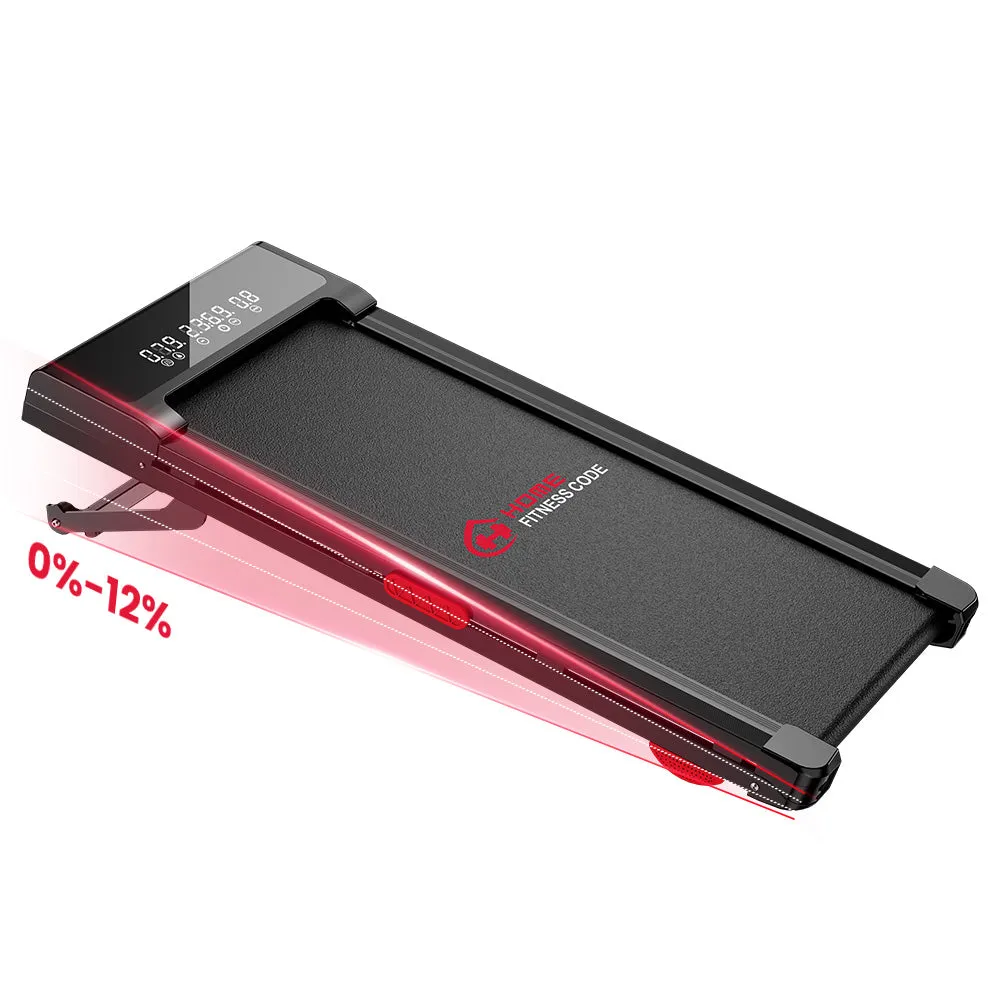
Automatic incline to 12 per cent on a brushless motor, a 150 kg user limit, 21 kg to lift and the lowest noise claim of the six at under 35 dB. It is the balance most Irish homes want, and it costs thirty euro more than the cheapest automatic model.
€199.99, from €279.99 · checked 18 September 2026
Check the Y3 priceDiscount codes
Discount code by country: 5% to 15% off
Choose your country to visit the relevant Home Fitness Code store and get your discount. Use codes: FIT5 or FIT15
Manual incline and automatic incline are not the same feature
Both get described as “incline” in product titles, and the gap between them is bigger than the price difference suggests.
Manual incline
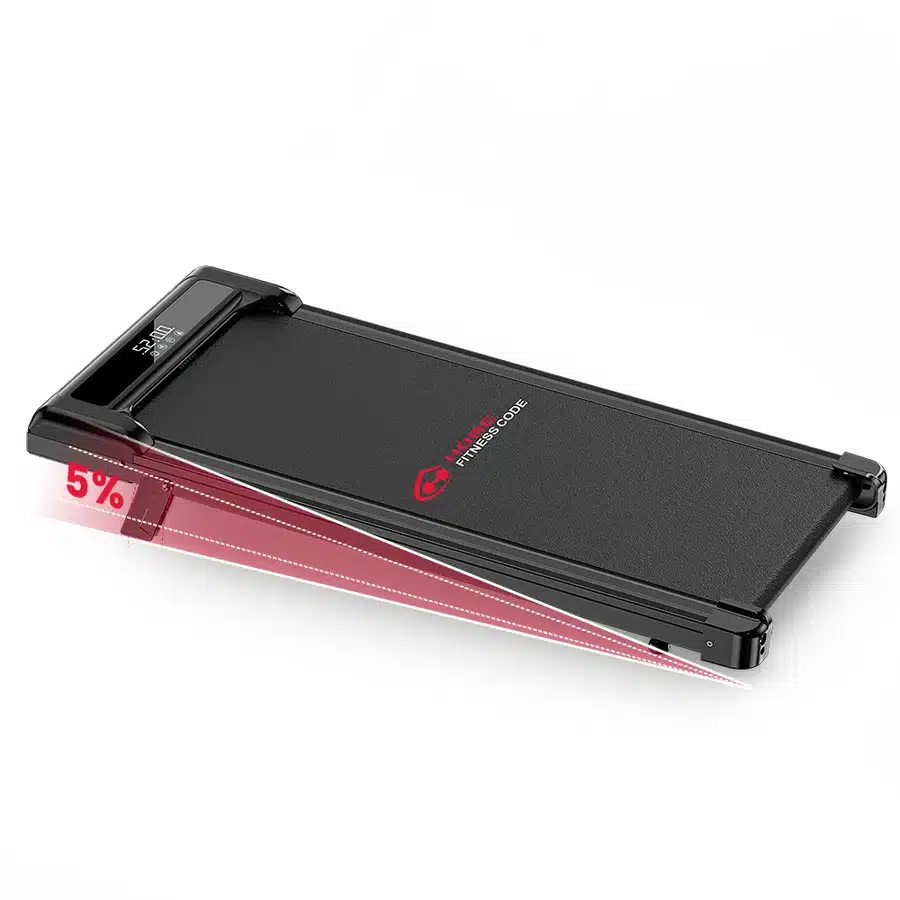
A fixed riser, usually a fold-out foot or a set of pegs under the front of the deck. You set it before you start and leave it there. On the Irish Home Fitness Code range this is a single 5 per cent setting rather than a range.
- Cheaper, and adds nothing that can break electronically.
- One angle only, and changing it means stepping off.
- Fine if you want a permanent slight slope for desk walking.
- No use for interval work or for easing off mid-walk.
Automatic incline
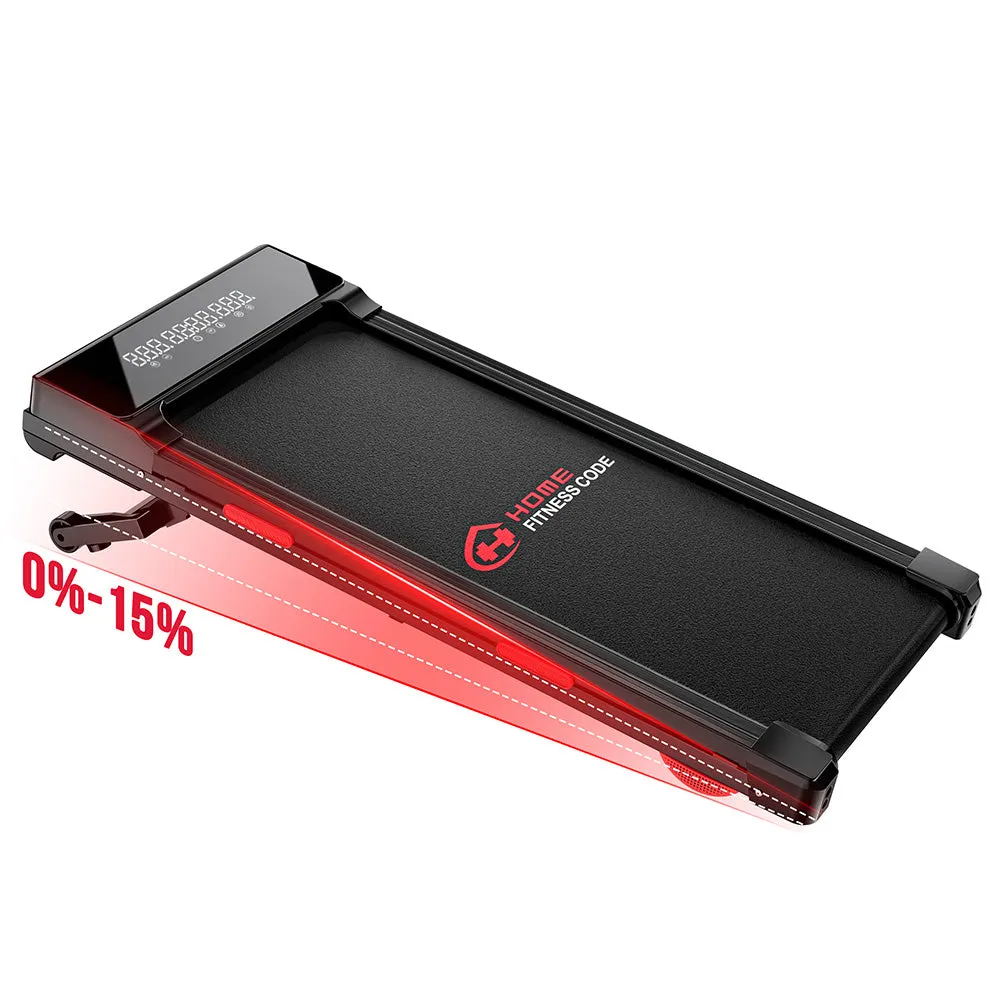
A motorised lift under the deck, changed from the remote while you walk. The Irish range goes to 12 per cent on the Y1 and Y3 and 15 per cent on the Y5, in steps rather than continuously.
- You can raise effort without touching the speed, which is the point of incline on a desk pad.
- Makes intervals possible: a few minutes up, a few minutes flat.
- More moving parts, more weight, and a higher price.
- Worth checking the incline still works at the low speeds you actually use.
A percentage is a gradient, not a degree. Five per cent is roughly a 2.9 degree slope, and 12 per cent is roughly 6.8 degrees. Those numbers look small written down and feel considerably less small twenty minutes into a walk.
What incline actually changes, and what it does not
Walking uphill is harder than walking on the flat at the same speed, which is uncontroversial and also the whole of the claim. Everything past that depends on you.
What it genuinely helps with
- Getting a meaningful walk at a speed low enough to type at. A slow flat walk is movement; a slow uphill walk is exercise.
- Making the same twenty minutes progressively harder over weeks without needing a faster belt.
- Variety, which matters more than it sounds for something you are trying to keep doing.
- Working calves and glutes noticeably more than flat walking does.
What it does not do
- It does not produce a specific calorie figure. Retailer graphics that promise a percentage more calories are marketing, not measurement, and the real number depends on your body weight, pace and duration.
- It does not make a walking pad a substitute for a treadmill if you want to run. Belt length is the limit there, not incline.
- It does not guarantee weight loss. Movement helps, and what you eat and how consistent you are matter more.
Incline raises effort, heart rate and load on the ankles, knees and lower back. If you are pregnant or recently postnatal, have a heart condition, joint problems or a chronic illness, take medication affecting heart rate or blood pressure, or have been inactive for a long time, speak to your GP or a qualified health professional before adding incline work. This page is general information, not medical advice.
For what walking pads realistically deliver over time, see do walking pads work.
Every incline walking pad sold into Ireland by Home Fitness Code
Home Fitness Code is the main walking pad retailer shipping into Ireland from a European warehouse, and six models in its Irish range list an incline. Three are manual, three are automatic. Every figure below is the retailer’s own published specification, checked on 17 September 2026.
| Model | Incline | Speed | Belt | Max user | Unit weight | Noise claim | Price checked |
|---|---|---|---|---|---|---|---|
| Treadmill T7 | 5% manual | 1–6 km/h | 90 × 38 cm | 120 kg | 16 kg | Under 40 dB | €99.99, from €279.99 |
| Treadmill C1 | 5% manual | 1–10 km/h | 97 × 39 cm | 120 kg | 17.5 kg | Under 50 dB | €99.99, from €269.99 |
| Treadmill Z3 | 5% manual | 1–6 km/h | 91.5 × 38 cm | 120 kg | 13 kg | Under 30 dB | €109.99, from €279.99 |
| Treadmill Y1 | 0–12% automatic | 1–10 km/h | 98 × 40 cm | 145 kg | 26 kg | Under 50 dB | €169.99, from €279.99 |
| Treadmill Y3 | 0–12% automatic | 1–10 km/h | 97 × 39 cm | 150 kg | 21 kg | Under 35 dB | €199.99, from €279.99 |
| Treadmill Y5 | 0–15% automatic | 1–10 km/h | 97 × 40 cm | 150 kg | 19.5 kg | Under 35 dB | €219.99, from €289.99 |
- The cheapest automatic model is the heaviest and the loudest on paper. The Y1 is listed at 26 kg with a brush motor and a noise claim of under 50 dB. The Y3, thirty euro more when checked, is listed at 21 kg with a brushless motor and a claim of under 35 dB. If the pad lives in a room where other people are, that gap matters more than the price gap.
- Manual incline is a 5 per cent setting, not a range. All three manual models list the same single angle, so the choice between them comes down to speed, noise and weight rather than incline.
- Prices were all discounted when checked. Every model showed a reduced price against a higher reference price. Treat the figures above as a snapshot from 17 September 2026 and check the current price before buying.
Noise figures, horsepower ratings and incline percentages above are the retailer’s published claims. GymBunny has not measured them. Horsepower is quoted by the retailer as peak, not continuous.
Also worth knowing: several of these models exist in a separate folding version with a handrail, sold under almost the same name. The folding versions are heavier and taller when stored. Check whether the product title says “Folding Treadmill” before you buy. The foldable walking pad guide covers that side of the range.
Which incline model suits which situation
These are editorial picks based on the published specifications above, current prices and who each model appears designed for. No model here has been physically tested by GymBunny.
Treadmill Y3, 0–12% automatic
The specification sheet is the strongest balance in the range: brushless motor, 150 kg user limit, 21 kg unit weight and the lowest noise claim of the three automatic models at under 35 dB. Incline is adjusted from the remote in steps up to 12 per cent, and the 1–10 km/h range covers desk walking through to a light jog.
Suits someone who will genuinely change the incline mid-walk, and who needs the pad to be quiet because it shares a room with other people or sits above a neighbour.
Think twice if you only ever want one fixed slope. A manual model does that for half the money.
Treadmill Z3, 5% manual
At 13 kg it is the lightest incline model in the Irish range and carries the quietest published claim of any of the six, under 30 dB. The trade-off is a 1–6 km/h belt, so it is a walking pad and not a jogging one, and the incline is a single fixed setting.
Suits a small flat or a room where the pad has to be lifted and stored daily, and anyone who wants a permanent slight slope for desk walking rather than a feature to play with.
Think twice if you want to run occasionally, or if you expect to vary the gradient.
Treadmill Y5, 0–15% automatic
Three per cent steeper than the Y3, on a 3.0 HP peak brushless motor, at 19.5 kg and with the same under 35 dB claim and 150 kg user limit. It is the most expensive of the six and the difference it buys is the top of the incline range rather than a better pad at 12 per cent.
Suits someone already comfortable walking at 12 per cent who wants headroom, or anyone deliberately using steep walking as their main cardio.
Think twice if you have not used incline before. Most people find the top of a 12 per cent range hard enough, and 15 per cent adds load on the knees and lower back.

Treadmill Y1, 0–12% automatic
The entry point into automatic incline, and the one to read the specification on carefully. It reaches the same 12 per cent as the Y3, but the retailer lists a brush motor rather than brushless, a noise claim of under 50 dB rather than 35, a lower 145 kg user limit and 26 kg of unit weight, which makes it the heaviest of the six to move or store.
Suits someone on a firm budget who wants adjustable incline, in a room where noise is not a consideration and where the pad can stay on the floor.
Think twice if the pad needs lifting regularly or the room is shared. The Y3 answers both for a modest amount more.
Not sure incline is the feature you need? The GymBunny walking pad Ireland buying guide compares the full range across price, noise, size and use case, and the walking pad reviews hub holds the detailed model reviews and brand comparisons.
Can you do 12-3-30 on a walking pad?
This is the question most incline searches are really asking. The 12-3-30 routine, popularised by Lauren Giraldo, means 12 per cent incline at 3 miles per hour for 30 minutes, which is about 4.8 km/h in Irish terms.
On paper, the three automatic models can do it. The Y1 and Y3 reach exactly 12 per cent, the Y5 goes past it, and all three cover 4.8 km/h comfortably inside a 1–10 km/h range. The three manual models cannot: 5 per cent is their only setting.
Belt length, not incline, is the limit. These pads list running surfaces of 97 to 98 cm. A full-size gym treadmill is typically 140 to 150 cm. At 4.8 km/h on a slope your stride lengthens, and on a one-metre belt that leaves very little margin at the front and back. It is doable, and it demands more attention to where your feet are than the same walk on a gym treadmill. Start at a lower speed or a lower gradient and build up rather than starting at 12 and 4.8 on day one.
What the routine is, in one video
Morgan Green walks through the routine, where it came from and the sensible caveats. It is background rather than a GymBunny recommendation, and nothing in it is specific to walking pads.
Video by Morgan Green on YouTube. GymBunny is not affiliated with the channel and earns nothing from the video.
If you want structured sessions built for a pad rather than a gym treadmill, the GymBunny results and how-to hub holds the walking plans and workouts.
What to check before you buy an incline model
- Whether it is the walking pad or the folding version. Several of these models exist in both. The names differ by one word and the stored size, weight and price do not.
- Whether the incline is a range or a single setting. Product titles say “5% Manual Incline” and “0-12% Auto Incline” and it is easy to read past that difference.
- The user weight limit against your own weight. These list 120 kg for the manual models and 145 to 150 kg for the automatic ones. Incline puts more load through the frame, so the limit matters more than on a flat pad.
- Height when stored, not just folded length. The automatic models carry a lift mechanism underneath, which is part of why the Y1 is 26 kg. Measure the gap under your sofa or bed before buying.
- The noise claim, and who else is in the room. The published claims across these six range from under 30 dB to under 50 dB. That is a wide spread, it is the retailer’s own figure, and it is measured under conditions the retailer does not publish.
- Delivery, returns and warranty for Ireland specifically. All six list a 12-month warranty at the time of checking. Confirm the current warranty, the returns window and who pays return postage from Ireland before ordering, since a 20 kg-plus return is not a trivial parcel.
- The current price. Every model was discounted against a higher reference price when this page was checked. A discount that is permanently on is a price, not an offer.
Buying somewhere other than the retailer’s own store? Where to buy walking pads in Ireland covers the delivery and returns differences, and the best walking pads under 200 euro covers the budget end of the range, incline or not.
Common questions about walking pads with incline
Is incline worth paying extra for?
It is if you will use it. Incline lets you raise effort at a speed you can still work at, which is the single hardest thing to achieve on a flat desk pad. If you expect to set a slope once and forget it, a 5 per cent manual model gets you most of that for roughly half the price of an automatic one.
What is the difference between 5 per cent and 12 per cent in practice?
Five per cent is a gentle slope, about 2.9 degrees, and most people can hold a normal working pace on it. Twelve per cent is about 6.8 degrees and is closer to a hill walk: conversation is still possible, typing usually is not. Twelve per cent is a workout setting rather than a background one.
Does incline burn more calories?
Walking uphill uses more energy than walking on the flat at the same speed, so more effort means more energy used. How much depends on your body weight, the gradient, the speed and how long you walk, which is why no honest single figure exists. Ignore any graphic promising a fixed percentage more calories, and treat the number on the pad’s own display as a rough relative measure only, since most walking pads estimate it without knowing your weight.
Can you run on these at incline?
The automatic models list speeds up to 10 km/h, which is a jog for most people, but the running surfaces are 97 to 98 cm. That is short for running and shorter still for running on a slope. Treat them as walking and light jogging machines. If running is the goal, a compact treadmill with a longer belt is the category to look at.
Does the incline work at very low speeds?
The retailer does not publish a minimum speed for incline operation on these models, and behaviour varies by machine. If slow uphill desk walking is the reason you are buying, ask the retailer to confirm that the incline operates across the whole speed range before you order.
Is a manual incline pad quieter than an automatic one?
Not automatically. In this range the quietest published claim belongs to a manual model, the Z3 at under 30 dB, but the loudest also belongs to two models with very different mechanisms: the manual C1 and the automatic Y1 both claim under 50 dB. Motor type matters more than the incline mechanism, and the brushless models carry the lower claims. All of these are retailer figures rather than measurements GymBunny has taken.
Do I need the handrail version?
Most of these models are sold with or without a handrail. A handrail adds a few kilogrammes and a good deal of stored height, and it is genuinely useful for anyone less steady on their feet or walking at a steeper gradient. For desk walking it usually gets in the way of the desk.
Discount codes
Discount code by country: 5% to 15% off
Choose your country to visit the relevant Home Fitness Code store and get your discount. Use codes: FIT5 or FIT15
Where to go next
-
Compare walking pads in Ireland
The full buying guide across price, size, noise and use case, incline or not.
-
Under-desk treadmills
If the pad is going under a desk, the constraints are different from the ones on this page.
-
Best walking pads under 200 euro
Where the manual incline models sit, and what you give up at that price.
-
Browse walking pad reviews
Detailed model reviews, brand comparisons and the reviews hub.
Prices, stock, specifications and warranty terms change. Everything on this page was checked against the Irish Home Fitness Code store on 17 September 2026. Confirm the current details on the retailer’s product page before buying.